Showing posts with label philosophy. Show all posts

Sunday, March 27, 2022

Book Blog #307: The Richest Man in Babylon by George S. Clason


Title: The Richest Man in Babylon

Author: George S. Clason

# of Pages: 194 (paperback)

Genre: Philosophical, Finance, Self-help 

Rating: ★★★☆☆

Synopsis: Countless readers have been helped by the famous “Babylonian parables,” hailed as the greatest of all inspirational works on the subject of thrift, financial planning, and personal wealth. In language as simple as that found in the Bible, these fascinating and informative stories set you on a sure path to prosperity and its accompanying joys. Acclaimed as a modern-day classic, this celebrated bestseller offers an understanding of—and a solution to—your personal financial problems that will guide you through a lifetime. This is the book that holds the secrets to keeping your money—and making more.

Review: I'm on a roll with these 3 star reviews. 

Definitely a huge contrast from Severance; this is very capitalist. While Ling Ma would tell you to NOT work until the end of the world, Clason's parables encourage people to have grit and determination, be hard working, and increase your wealth through smart investments. My favorite quote: “In my youth I looked about me and saw all the good things there were to bring happiness and contentment. And I realized that wealth increased the potency of all these. Wealth is a power. With wealth many things are possible” (p.13). 

This book was okay. Short but not sweet - The Richest Man in Babylon was about 3 times too long. Like a long winded email, the main points could have been easily summarized in a bulleted list (you can find such a list on the Wikipedia page for this book). The parables provide basic financial advice that seem intuitive once you read them, covering the main tenants/rules in broad strokes and thus making it a pretty simplistic read despite the old fashioned language. 

My takeaways were: as long as you are determined to be wealthy, you can be. Once you are determined, seize opportunities because luck comes most to those who do not hesitate. Then, when you have some sort of income no matter how small, save (and keep safe) at least a tenth of it and invest it WISELY (huge emphasis on not making a dumb investment - this point was repeated multiple times throughout the book). Finally, you are rich. 

Congrats! If you read this review, you don't have to read the book. I just saved you a couple hours of reading. In all seriousness, it's not a bad book, but it's long winded; reading a summary would be sufficient. 


Saturday, December 22, 2018

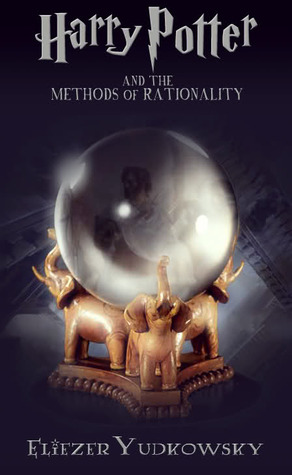
Book Blog #228: Harry Potter and the Methods of Rationality by Eliezer Yudkowsky

Title: Harry Potter and the Methods of Rationality
Author: Eliezer Yudkowsky
# of Pages: 2007 (ebook)
Genre: Fan Fiction, Fantasy, Philosophy
Rating: ★★★★☆
Synopsis: Harry Potter and the Methods of Rationality is a work of alternate-universe Harry Potter fan-fiction wherein Petunia Evans has married an Oxford biochemistry professor and young genius Harry grows up fascinated by science and science fiction. When he finds out that he is a wizard, he tries to apply scientific principles to his study of magic, with sometimes surprising results.
Review: This is probably the best, most well-written fan fiction I've ever read.

This is not your ordinary fan fiction. It's not written by a 12 year old girl in her dark bedroom typing out her pubescent fantasies. Eliezer Yudkowsky is an AI researcher who put a playful twist on the Harry Potter story by making Harry more rational than he is in the original series. When you read HPMOR, you'll forget you're reading something that is technically clumped in the same genre as dracoxharry erotica.

I was wavering between giving HPMOR 3 stars and 4 stars (so it's actual rating is probably more like a 3.5). I loved the beginning and ending third of the book, but some plots made me lose interest in the story (and made me want to stop reading the fic in general).


However, after I finished reading, I couldn't stop thinking about what I read. I browsed the HPMOR subreddit to fill the new void in my life (I've been slowly reading the first half of this book since January and read the second half over the last few days). I like a book that leaves me thinking, thus the additional star.

That being said, it's difficult to rate this book amongst traditionally published books. There are other factors working against it; it didn't get a run through by a professional editor (this could have helped Yudkowsky tie the subplots closer together or remove ones that are unnecessary).

It is also EXTREMELY long (this might be the nature of fan fictions as they are not constrained length-wise as ebooks). Goodreads has this book listed twice; one being one large book and the other being a series of 6 stories (the large book is broken up into 6 parts). If this were a traditionally-published work, this would be closer to how it would appear in book stores.

However, each of these 6 parts is not a self-contained story. It is best read as a whole, back to back, thus should be considered to be one book. The problem with this is 2000 pages is a huge commitment for most readers (I was reading it through the HPMOR website and was wondering why it was taking me so long to get through it). To prevent reading fatigue, this book SHOULD have somehow been broken up into multiple, self-contained parts.

Nevertheless, I would HIGHLY recommend this fan fiction to anyone who is already a fan of the Harry Potter series. Some parts of this fan fiction act as a parody of the original (which includes poking fun at it), but this is a big part of the fun of the book. Not only will it have you thinking about certain situations from the original Harry Potter books more rationally, but it will also have you laughing throughout the journey.

Monday, August 15, 2016

Book Blog #186: Candide by Voltaire

Title: Candide
Author: Voltaire
# of Pages: 176 (paperback)
Genre: Fiction, Philosophy, Classics
Rating: ★★★☆☆
Synopsis: One of the finest satires ever written, Voltaire’s Candide savagely skewers this very “optimistic” approach to life as a shamefully inadequate response to human suffering. The swift and lively tale follows the absurdly melodramatic adventures of the youthful Candide, who is forced into the army, flogged, shipwrecked, betrayed, robbed, separated from his beloved Cunégonde, and tortured by the Inquisition. As Candide experiences and witnesses calamity upon calamity, he begins to discover that all is not always for the best.
Review: In the past two weeks, I've read One Flew Over the Cuckoo's Nest, One Hundred Years of Solitude, and Antigone, all of which (spoilers) end generally in an unhappy manner.

Candide, a book directly challenging the philosophy of optimism, just puts the icing on the cake for my series of "downer" reads.

The beginning of Candide was definitely enjoyable; Voltaire's use of satire and irony made a story I initially had no interest in more than endurable. However, Candide's numerous encounters with the world's misery not only lowered the morale of the characters, but the morale of the reader. While the ending is somewhat hopeful, I have been shocked so much by the despair and pessimism that I have realized that I do no like this book as much as I did initially.

Very depressing. Although the story is pretty interesting, I would not recommend this book to anyone who is looking for a "feel-good" book.