Showing posts with label memoir. Show all posts

Tuesday, September 17, 2024

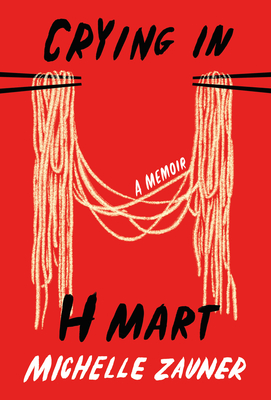
Book Blog #344: Crying in H Mart by Michelle Zauner


Title: Crying in H Mart

Author: Michelle Zauner

# of Pages: 341 (ebook)

Genre: Nonfiction, Biography

Rating: ★★★☆☆

Synopsis: In this exquisite story of family, food, grief, and endurance, Michelle Zauner proves herself far more than a dazzling singer, songwriter, and guitarist. With humour and heart, she tells of growing up the only Asian-American kid at her school in Eugene, Oregon; of struggling with her mother’s particular, high expectations of her; of a painful adolescence; of treasured months spent in her grandmother’s tiny apartment in Seoul, where she and her mother would bond, late at night, over heaping plates of food. As she grew up, moving to the east coast for college, finding work in the restaurant industry, performing gigs with her fledgling band – and meeting the man who would become her husband – her Koreanness began to feel ever more distant, even as she found the life she wanted to live. It was her mother’s diagnosis of terminal pancreatic cancer, when Michelle was twenty-five, that forced a reckoning with her identity and brought her to reclaim the gifts of taste, language, and history her mother had given her.

Review: No one told me that singer Michelle Zauner (aka singer under the name Japanese Breakfast) could write! 

Crying in H Mart caught my attention from the title alone - who is this person, and why is she crying in the iconic Korean grocery store? Little did I know that this book is actually a heartfelt memoir about her mother's battle with her cancer AND Zauner's struggles with identity, culture, and relationships. 

I can't exactly criticize the story. Zauner's complicated yet close relationship with her mom is likely relatable to many people, especially Asian Americans growing up with immigrant parents. For those who can't relate, it provides insight into what it's like growing up as a halfie and how closely food ties into her relationships on her Korean side of her family/family friends.

That being said, while I was reading this book BEFORE realizing Zauner is Japanese Breakfast, I didn't think this story was particularly notable despite being pretty well written. It's an unfortunate reality that many people know of a loved one who battled cancer, and Zauner's struggle with identity is not too different from other books I've read relating to growing up Asian American, as a minority. It's because it's NOT a very unique story that there's a large audience of people who's hearts it can easily touch from being so relatable. 

This aside, the only minor complaint I have is how non linearly the story is told. Jumping back and forth between her parents' past as well as her own past maybe the story a lot less gripping for me, and I found myself not feeling the urge to pick up the book again for days. 

If the topic of Crying in H Mart sounds interesting to you, definitely give it a shot. I almost gave this book 4 stars because I have no regrets reading this book, but I didn't cry over it (at most slightly teared up if I thought hard enough about it) and didn't feel invested in the story. It's also cool to hear more background on the person behind Japanese Breakfast even though I don't listen to the artist's music.

Sunday, August 2, 2020

Book Blog #271: Educated by Tara Westover


Title:
 Educated
Author: Tara Westover
# of Pages: 334 (hardback)
Genre: Nonfiction, Autobiography, Memoir
Rating: ★★★★★
Synopsis: Tara Westover was 17 the first time she set foot in a classroom. Born to survivalists in the mountains of Idaho, she prepared for the end of the world by stockpiling home-canned peaches and sleeping with her "head-for-the-hills bag". In the summer she stewed herbs for her mother, a midwife and healer, and in the winter she salvaged in her father's junkyard. Her father forbade hospitals, so Tara never saw a doctor or nurse. Gashes and concussions, even burns from explosions, were all treated at home with herbalism. The family was so isolated from mainstream society that there was no one to ensure the children received an education and no one to intervene when one of Tara's older brothers became violent. Then, lacking any formal education, Tara began to educate herself. She taught herself enough mathematics and grammar to be admitted to Brigham Young University, where she studied history, learning for the first time about important world events like the Holocaust and the civil rights movement. Her quest for knowledge transformed her, taking her over oceans and across continents, to Harvard and to Cambridge. Only then would she wonder if she'd traveled too far, if there was still a way home.
Review: This book was not what I was expecting at all.
I knew the basic premise; Mormon girl is born into a radical family, doesn't get a formal education, and then somehow she is able to go to college and excel academically. As per the title of the book, I assumed it would be a story focusing more on the struggle of being able to achieve higher education without any formal education. However, I was surprised to find that the struggle she focused on was with her family, being able to separate her goals and beliefs from her family's, and becoming her own person. 
I wavered between giving this book four stars or five. Initially, I was set on giving it four stars because while the story she was telling was interesting, it was a bit of a slow start; a lot of character development for each member of Westover's family and setting the scene with her parents' radical beliefs. What made me give it the final star was how gripping the rest of the book was; I couldn't put it down today. When Westover grows older and less complacent to her parents, it is easier to empathize with her. I felt STRESSED for her, and every family conflict she described made me feel the frustration, sadness, and fear she must have been feeling. Whenever a book makes me feel like this, I applaud it. 
Several times while I was reading this book, the song Who Lives, Who Dies, Who Tells Your Story from Hamilton (I know this might sound irrelevant but bear with me). With all the gaslighting she endures from the people she is suppose to love and trust, Westover is using this book as an opportunity to reclaim the narrative. Everyone involved seems to be an unreliable narrator, Tara included (and she admits this herself throughout the book), and although Westover does her best to compile different perspectives together to form as close to the truth as possible in the story of her life, the reader is left to try to decipher what really happened and to make their own evaluations of each person's character. 
One thing I really loved about this book is no one seems truly bad to the core. In the end we are all human, and Westover recognizes this. Even the people who have had a overall negative impact on her life (effectively, the antagonists of the story) did not necessarily have bad intent. Even those with bad intentions had their good moments.
Something I wanted more of was a deeper dive into the relationships she formed/strengthened after she got into college. There seemed to be many people who supported her in finding herself (i.e. friends, professors, relatives), but their character development was weak. Additionally, there were many lines that were paraphrased, but I questioned whether lines were more eloquently stated in this book than reality. For written correspondence, it would have nice to get the direct quote because words/syntax can real reveal who the speaker is and what their character is.
Overall, it was very much worth the read. I would recommend this book to anyone interested.


Saturday, July 21, 2018

Book Blog #216: One Litre of Tears by Aya Kito

Title: One Liter of Tears
Author: Aya Kito
# of Pages: 270 (ebook)
Genre: Nonfiction, memoir, biography
Rating: ★★★★☆
Synopsis: Aya Kitō was diagnosed with a disease called spinocerebellar degeneration when she was 15 years old. The disease causes the person to lose control over their body, but because the person can retain all mental ability the disease acts as a prison. So in the end she cannot eat, walk or talk.Aya keeps a diary of not only what she does but how she feels and the hardships she must endure. Initially, the diary's purpose was for Kitō to chronicle impressions she had about how the disease was affecting her daily life. As the disease progressed, however, the diary became Kitō's outlet for describing the intense personal struggles she underwent in coping, adapting, and ultimately trying to survive her disease. As she notes in one entry, "I write because writing is evidence that I am still alive."
Review: It is always difficult to judge a book by its translation.

I read this book because I watched the J-drama of Anya’s story and wanted to know how accurate its portrayal of her disease is.

(I’m not marking any of this as a spoiler since it’s nonfiction.)

The start of the book is her diary, which reflected similar sentiment I saw in the J-drama version of Aya. However, near the end of the book when the doctor is giving her (interestingly the doctor is male in the drama even though she is female in real life) version of Aya’s life, she recalls how the school administration insisted Aya go to a disabled school. This is also in the drama; however, unlike in the doctor’s retelling where she states that Aya’s peers were “fighting against the move,” many students were portrayed in the drama as reluctantly agreeing that Aya was an inconvenience in school and should be transferred. The way the creators of the drama recreated the events that led up to Aya’s transfer strongly indicate that the transfer was the obvious choice to benefit all parties involved. What I liked about the doctor’s perspective was how she casts a different light on the situation; instead of seeing Aya as an inconvenience, she discusses how Aya’s condition brings out the caring nature in others and how exposure to her serious attitude she developed during the fight for her life could have helped her peers grow and improve in character.

I wasn’t surprised to find the romantic part of the drama to be extremely exaggerated. However, I was surprised by the doctor’s memory of Aya asking if she could get married and of a period of time when a medical student around her age would visit her, hinting toward the possibility of romance. Although it is not on the scale of what was depicted in the drama, it is nice to know it is not completely made up.

Overall, this publication of Aya's diary and her doctor's and mother's account of Aya's life with her disease were exactly what I expected. It is a very quick read, but it is amazing to hear from the perspective a girl who had such a difficult disease to live with.

Wednesday, February 4, 2015

Book Blog #154: Lucky by Alice Sebold

Title: Lucky
Author: Alice Sebold
# of Pages: 256 (hardback)
Genre: Non-fiction, Memoir, Autobiography
Rating: ★★★☆☆
Synopsis: Alice Sebold reveals how her life was utterly transformed when, as an eighteen-year-old college freshman, she was brutally raped and beaten in a park near campus. What propels this chronicle of her recovery is Sebold's indomitable spirit-as she struggles for understanding ("After telling the hard facts to anyone, from lover to friend, I have changed in their eyes"); as her dazed family and friends sometimes bungle their efforts to provide comfort and support; and as, ultimately, she triumphs, managing through grit and coincidence to help secure her attacker's arrest and conviction. In a narrative by turns disturbing, thrilling, and inspiring, Alice Sebold illuminates the experience of trauma victims even as she imparts wisdom profoundly hard-won: "You save yourself or you remain unsaved."
Review: This exceeded my expectations.

I was shocked. Sebold included graphic images of her rape in her book, (so if that is going to bother you, don't read this book) which I thought was amazing - she could describe such a difficult situation in such detail.

It is well written, though she mentions a lot of different people, which was confusing for me (and the reason why the rating I am giving it isn't extremely high).

If you are interested in this book at all, even if you haven't read/watched Lovely Bones (like me), definitely read it!

Friday, January 16, 2015

Book Blog #152: Hidden Girl: The True Story of a Modern-Day Child Slave Shyima Hall

Title: Hidden Girl: The True Story of a Modern-Day Child Slave
Author: Shyima Hall
# of Pages: 232 (hardback)
Genre: YA, Memoir, Non-fiction
Rating: ★★★☆☆
Synopsis: Shyima Hall was born in Egypt on September 29, 1989, the seventh child of desperately poor parents. When she was eight, her parents sold her into slavery. Shyima then moved two hours away to Egypt’s capitol city of Cairo to live with a wealthy family and serve them eighteen hours a day, seven days a week. When she was ten, her captors moved to Orange County, California, and smuggled Shyima with them. Two years later, an anonymous call from a neighbor brought about the end of Shyima’s servitude—but her journey to true freedom was far from over.
Review: While Shyima's story is a great one to learn of, it's presentation through this book degrades its quality.

I was hoping the writing wouldn't be as simplistic as it was....something that may have been fixed with better editing and writing help. She would also tend to repeat herself excessively. Due to the writing style, I couldn't sympathize with Shyima as much as I might have been able to.

In addition, most of the story was about her life AFTER slavery. It was very inspirational to read about how accomplished she became after escaping bondage, but I didn't think it was going to be a memoir of her whole life.

There was a lot left to desired. If you want to learn of Shyima, it would be much faster if you Googled her.

Tuesday, November 18, 2014

Book Blog #141: Night by Elie Wiesel

Title: Night
Author: Elie Wiesel
# of Pages: 120 (hardback)
Genre: Memoir, Classics, Holocaust
Rating: ★★★☆☆
Synopsis: Night is a work by Elie Wiesel about his experience with his father in the Nazi German concentration camps at Auschwitz and Buchenwald in 1944–1945, at the height of the Holocaust and toward the end of the Second World War. In just over 100 pages of sparse and fragmented narrative, Wiesel writes about the death of God and his own increasing disgust with humanity, reflected in the inversion of the father–child relationship as his father declines to a helpless state and Wiesel becomes his resentful teenage caregiver.
Review:  I feel cheated.

I read the "new" translation of this book (in English) by Elie Wiesel's wife, Marion Wiesel. While I felt I could learn from Elie's story, I felt as if significant parts of it are missing.

Is it the translation that is the problem? Maybe. Is it the changes the author made to the new edition? This is more likely the reason. In the preface, he says he took out parts of the end of the story about his father and the Liberation because they were "too personal, too private." I am thankful that he did include an excerpt of what he removed because I realize what I have missed by reading this version.

The "personal" and "private" parts of the book are what I wanted to read about. It's these parts that really connect with me, not the inexpressive words Elie replaced them with.

For this version, I give three stars. But a book with the old excerpts leaves me wondering how much better the original is and wanting to see more of the book that allowed  Elie to win the Nobel Peace Prize.

For those of you who have not read this book: it reminds me a lot of Animal Farm. It's short (but far from sweet) and easy for the masses to understand. However, a significant amount of meaning is lost (even to me; there are section of this book that I feel I do not fully understand) unless the reader looks for importance of every aspect of the book. Yes, it is one of THOSE  books (sorry people who are reading this for school!).

The reader needs to be pretty aware of the background/history of the Holocaust, or at least be willing to learn along the way. Another reason why I lacked a connection with the book was my difficulty UNDERSTANDING: the Holocaust, the religion, the war. If you don't do your research, this book will be even less meaningful.

I do recommend reading this  book (don't expect a happy read), although perhaps not this version.

Monday, October 27, 2014

Book Blog #136: The Glass Castle by Jennette Walls

Title: The Glass Castle
Author: Jeannette Walls
# of Pages: 288 (hardcover)
Genre: Nonfiction, Biography, Memoir
Rating: ★★★★☆
Synopsis: When sober, Jeannette's brilliant and charismatic father captured his children's imagination, teaching them physics, geology, and how to embrace life fearlessly. But when he drank, he was dishonest and destructive. Her mother was a free spirit who abhorred the idea of domesticity and didn't want the responsibility of raising a family.

The Walls children learned to take care of themselves. They fed, clothed, and protected one another, and eventually found their way to New York. Their parents followed them, choosing to be homeless even as their children prospered.
Review: One main thought came to my mind when I was reading this book; this family is crazy.

Now, based on the synopsis, I thought this was going to be a sob story. The cover didn't help as a grudgingly picked up this book. But Walls' approach is fantastic in The Glass Castle. She's not complaining about her life; she's just retelling it the way it was with some of it positive and some of it negative. Just how life is.

The Walls family is so different from my own, I wasn't sure of what to make of it. But I loved it. I didn't realize it, but I didn't know the true way a family like Walls' was like until I read this book. And it shows the reader that you can't label a child based on his or her parents' characteristics, habits, etc.

I urge everyone to read this book!