


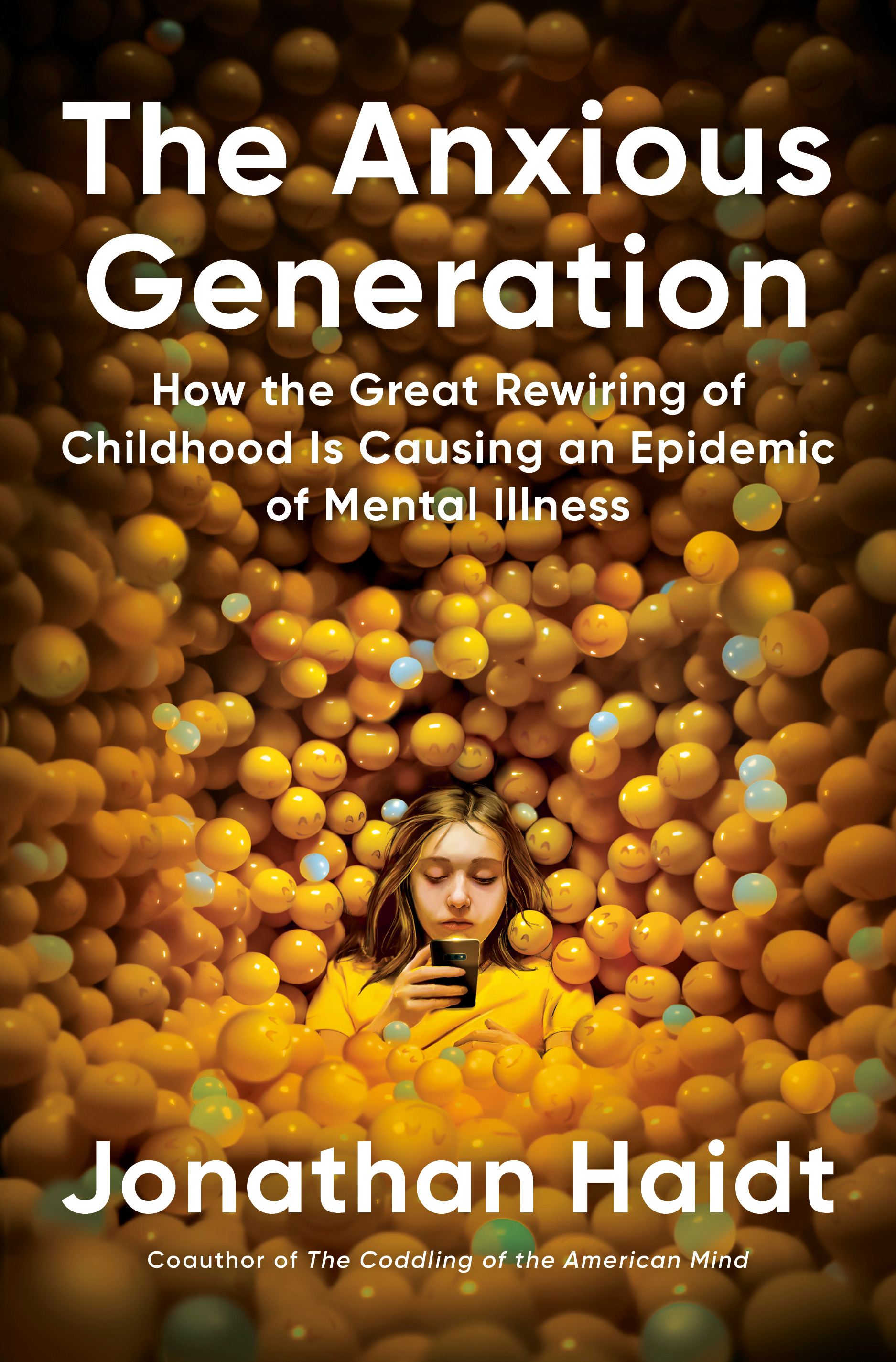
Author: Jonathan Haidt
# of Pages: 295 (hardback)
Genre: Nonfiction, Psychology, Self-help
Rating: ★★☆☆☆
Synopsis: After more than a decade of stability or improvement, the mental health of adolescents plunged in the early 2010s. Rates of depression, anxiety, self-harm, and suicide rose sharply, more than doubling on many measures. Why? In The Anxious Generation, social psychologist Jonathan Haidt lays out the facts about the epidemic of teen mental illness that hit many countries at the same time. He then investigates the nature of childhood, including why children need play and independent exploration to mature into competent, thriving adults. Haidt shows how the play-based childhood began to decline in the 1980s, and how it was finally wiped out by the arrival of the phone-based childhood in the early 2010s. He presents more than a dozen mechanisms by which this great rewiring of childhood has interfered with children’s social and neurological development, covering everything from sleep deprivation to attention fragmentation, addiction, loneliness, social contagion, social comparison, and perfectionism. He explains why social media damages girls more than boys and why boys have been withdrawing from the real world into the virtual world, with disastrous consequences for themselves, their families, and their societies. Most important, Haidt issues a clear call to action. He diagnoses the collective action problems that trap us, and then proposes four simple rules that might set us free. He describes steps that parents, teachers, schools, tech companies, and governments can take to end the epidemic of mental illness and restore a more humane childhood.
Review: It's extremely apparent from this book that Jonathan Haidt is a boomer.
Y'know how children joke about their grandparents being overly nostalgic over the past and being convinced that things were better "back in the day"? The Anxious Generation is basically that but in essay format. The TLDR is that social media and screen time is bad is excess and largely influenced by the culture of "everyone" being online. None of these points were particularly novel and follow common sense.
While I was hooked by the books opener, Parts 1 and 2 were a bit drier. This is when I discovered that the books format was going to be more essay-format; many study citations and data driven assertions (which is good although some studies were older than I expected to be used in this relatively recently published book). The highlight of these sections were how Haidt emphasizes antifragility and its importance that children develop it (this is a takeaway that's value for even adults who are looking to continue to grow).
The chapters in Part 3 were when it became more interesting, especially in Chapter 6: Why Social Media Harms Girls More Than Boys. Haidt highlights sociogenic illness (social media promotes the propagation of an illness from influencers to their followers). This is a phenomenon that many have likely seen (rise of influencers with Tourettes or multi-personality disorder) which is met with online discourse over whether said influencers are faking their illnesses/disorders. I was shocked to see that this was a tangible, observed trend from medical professionals as well. This chapter also (more controversially) highlights that this also might apply to the lgbtq community.
Unfortunately Part 3 also contains the worst chapter. Chapter 8: Spiritual Elevation and Degradation excited me at first because Haidt begins it by saying he wants to write the chapter "less as a social scientist than as a fellow human being who has felt overwhelmed, personally and perpetually, since 2014" (p.199). This is how I wanted him to write the whole book; less like an essay and more as a heart to heart from someone with deeper knowledge on social media's impact who could make it more understandable in a practical way! However, this chapter instead covers an agnostic view on spirituality, covering some topics related to inner peace drawing from some high level lessons from actual religions. This chapter didn't resonate with me at all and could've been cut completely.
I was also pretty disappointed with Chapter 7: What Is Happening to Boys?, which handwaves its way through only two negative areas: pornography and video games. The TLDR for both is that addiction to either negatively impacts boys, which is also common sense and so much weaker of a revelation than what Haidt asserts for girls.
It was disappointing that Haidt only includes one line on what I would hypothesis is the bigger negative impact for boys; them getting sucked into the manosphere and influenced by harmful ideologies: “Without positive male role models in their lives, many boys turn online for guidance, where they are easily led down rabbit holes into online communities that may radicalize their thinking” (p.262). This line isn't even include in this chapter; it's include in the latter half of Part 4. This is a topic that came up in the Netflix mini-series Adolescence last year, so I was expecting Haidt to have at least acknowledged this hypothesis and included some research on whether there is some correlation between boy's social media use and incel culture.
Overall I didn't consider this worth the read. Many non-fiction books feel like they could have been an email instead unless you are in academia; this book is no exception. It could have been more well rounded; Haidt would sound less like a boomer if he focused less on going "back" to play-based childhood and leaned more into a holistic evaluation of social media/technology to highlight how parents and children can be empowered by it (to better drive home his calls to action in the new hybrid of play and phone based childhoods).

No comments:
Post a Comment